
Ann’s Purpose: Thoughts on an Irish Girl and a Seedling

Updated: Sep 24
On July 2nd, 2026, the second twinning ceremony between the town of Ranthangan, Ireland, and the town of Freehold Borough, New Jersey, occurred on the lawn of the Monmouth County Historical Association. A copper beech tree was planted in each town, uniting them in memorialization of the tree brought to America in 1853 by Bruce Springsteen’s great-great-grandmother, Ann Garrity, as she left Ireland - and the famine - behind her. She planted the tree in front of what would become Bruce’s childhood home on Randolph St,. where it grew into something iconic and treasured, just as he did.
At the ceremony, it was pondered why a 14-year-old girl would bring a beech seed, of all things, across the Atlantic. Yes, it is entirely possible it was just a simple remembrance of something beautiful from her homeland. But could it have been something more? Perhaps.
Beeches have graced the landscape of southern England for millennia, ever-present in the most spiritual and magical of ancient Druidic places. The enormous stone circle of Avebury - dwarfing that of Stonehenge - and the unashamedly phallic site Cerne Abbas, visited by maidens for centuries to ensure their fertility, are nestled in near proximity to lush beech groves, although the ones that currently stand are most likely 17th-century plantings. But closer still to Ann, beeches were introduced to Ireland’s County Kildare around this time, springing up to encircle St. Brigid’s well, a spiritual place. She may have visited there, like so many others, to pray for health and hope. It would have been a pilgrimage that was accessible to her, and possibly one done before her long journey. Perhaps her seedling was born from the beeches around this sacred place, a pilgrim’s token taken as a measure of protection.
Making wishes is ubiquitous in every culture; stars, dandelions, and rainbows can attest to that. Irish folklore marks the beech as the Tree of Wishes, where the hopeful must write their wish upon the branch of a fallen birch limb and bury it in the ground for the Faerie Queen’s consideration. And why not? Beeches are closer than stars.
The beech has been given a maternal personification, offering shelter beneath her thick canopy, and sustenance from her plentiful nutrient-dense nuts. The valuable fat, protein, carbohydrates, and vitamins in the little triangular nuts, known as beech mast, staved off starvation and malnutrition for many over the centuries, from foraging neolithic clans to the mid-nineteenth century Irish during the potato famine. The nuts were so revered that they became symbols of good luck; a beech nut in your pocket could ward off negativity and harm, and hopefully bring good fortune. Ancient protectors, to be sure, and a handy thing to have on an ocean voyage.
Perhaps more colorfully, Celtic mythology abounds with tales of gods and goddesses associated with this natural symbol. The majestic beech holds the impressive titles of “Queen of the Forest,” and “Mother of the Woods,” symbolic of feminine wisdom, patience, and prosperity. Ironically, the god specifically representative of the tree is the male Fagus, but some credit is due to him for at least recognizing these inherent female gifts. While Fagus is the god, Phagos is the letter that represents the all-important beech tree in the ancient Celtic alphabet of Ogham. Created by the god Ogma, a warrior poet and the god of eloquence, it was a way to preserve the ancient Irish language and to separate the learned and mystical from the uneducated.
The noble beech is not done with us yet. While the gods gave the early Celts a way to preserve their language, what were they to do with it? Write it upon beeches, naturally! The earliest Europeans wrote directly onto the smooth bark of beech trees, an ancient practice that even Helen of Troy reportedly engaged in, carving the name of her lover onto a beech as many had done before her. Finding tree trunks less-than-portable, however, people began shaving off thin slices of beech bark to bring their writings along with them, and so were born the earliest of European “books;” the tree soon became closely associated with written knowledge.
Being so closely associated with secret languages and written knowledge, beeches gained a reputation for imparting wisdom. There is no direct correlation between the Irish Brigid, goddess of poetry and wisdom, and the beech. The Celtic goddess Ceridwen, however, is Brigid’s Welsh counterpart, and she is very much associated with the tree. Ceridwen was a shape-shifter, transforming into a white sow called Henwen. In this form, she consumed copious amounts of beech nuts, gaining the tree’s knowledge and becoming an incredibly powerful symbol of both nourishment and the limitless wisdom of the underworld, or the domain of the gods. Did 14 year-old Ann Garrity know of these mythological tales? Maybe…maybe not.
Coming down to Earth for a moment, the beech is not just a mythological symbol of written knowledge or wisdom; it is also a symbol of tradition, and it is here that we may find Ann’s purpose, if it was not simply a token of something pretty from home. The beech tree has long been known for its medicinal properties, and seems a veritable medicine chest, particularly for delicate Irish skin. Due to the high content of tannins that result in tissue-tightening astringent properties, topical poultice applications act to reduce weeping from sores, while forming a protective barrier that promotes healing. For those who suffer from psoriasis and eczema, polyphenols and tars in the bark help slow the growth of skin cells that cause psoriasis plaques, calm the hyperactive immune response that triggers eczema, and reduce redness and swelling. Compounds in the bark help to numb itchy skin, while the antimicrobial properties of gallic and caffeic acid help to disinfect wounds. Internally, a tea of beech bark could treat diarrhea, a common symptom of malnutrition.
Finally, a compound in beech wood called creosote was traditionally used in 19th-century medicinal preparations to treat respiratory illnesses. Containing a relative of the popular and effective modern expectorant guaifenesin, found in many over the counter medicines today, creosote helped to thin and expel chest congestion to ease the suffering of those with tuberculosis, bronchitis, and the flu. It would have been a very useful thing to have at hand.
And so now we return to a young Ann Garrity on a crowded ship bound for America, bearing the responsibility of caring for her two younger sisters, Catharine and Elizabeth, on the voyage. We can only wonder if she sought escape in mythology or fairy tales in the midst of famine-stricken Ireland, forced to face the harsh realities of watching those she loved struggle with poor health as a result of poverty and malnutrition. Of course, there is always hope for better things, which Irish folklore ascribed to the ancient beech. The seed she planted may have been just a superstition, or perhaps a practical way to take care of her family in the strange new place that was to be her home. And she did.
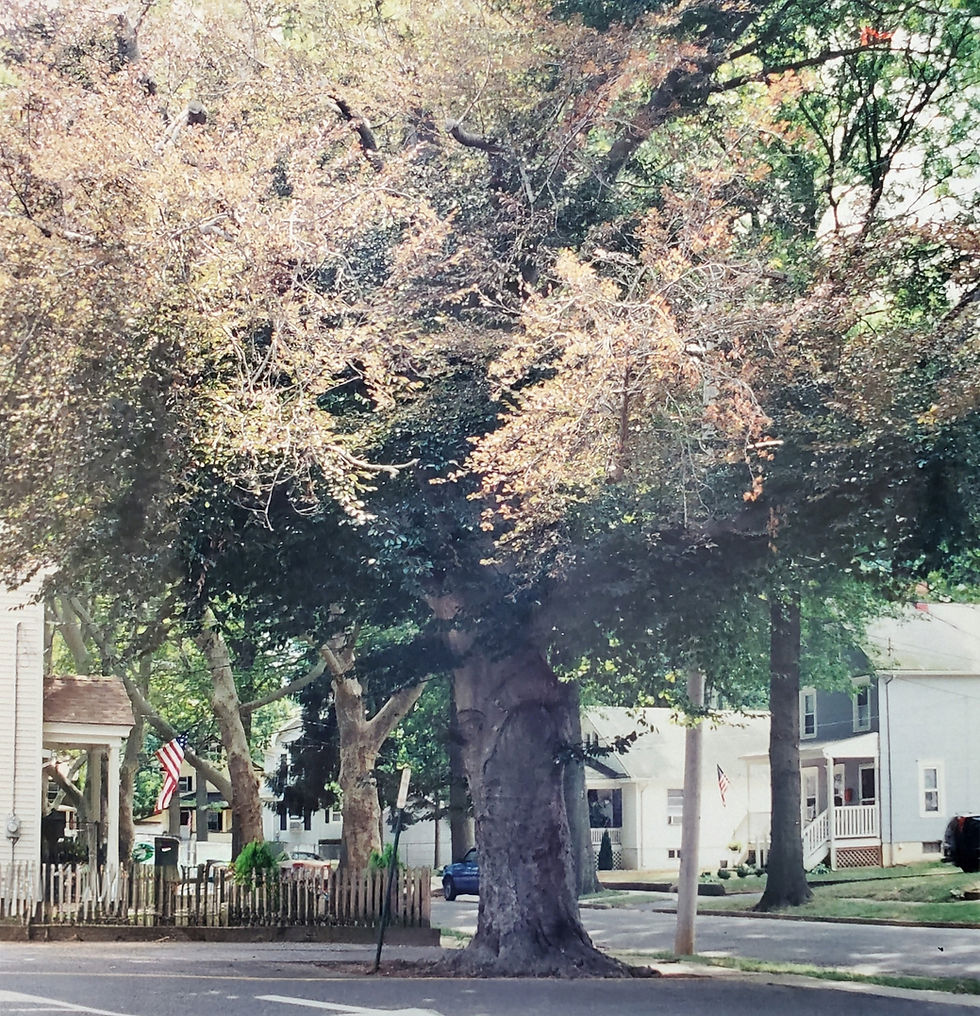
The copper beech tree on Randolph St.
Photo courtesy of Glenn Cashion's personal collection


